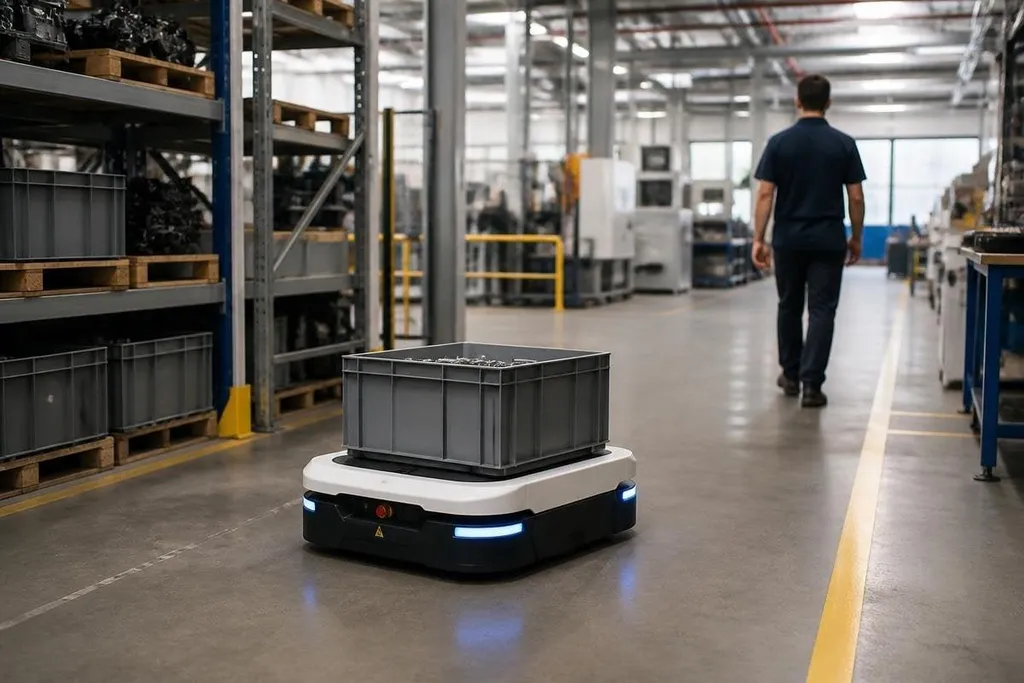
A mobile robot can carry parts across a factory, move bins through a warehouse, or inspect a site without a driver onboard. The gain comes from removing repeated travel, while the risks start when floors, people, software, or safety rules differ from the plan.
- Mobile robots save staff time on repeated transport tasks.
- Cameras, LiDAR, and maps help robots move around fixed obstacles.
- Poor layouts, weak network coverage, and unclear safety rules can stop a project.
Where mobile robots help
The clearest use is transport. An autonomous mobile robot, or AMR, moves through a work area and chooses a route from its map and sensor data. An automated guided vehicle, or AGV, usually follows a fixed path such as a magnetic strip, wire, or marked route.
That difference matters to a site manager. An AMR can change its route when a pallet blocks an aisle, while an AGV may need a changed guide path or a manual reset. Both types can move stock, but the right choice depends on how often the site layout changes.
Mobile robots also reduce walking between work points. A worker can load a cart at one station while the robot carries material to another. The worker still handles the task that needs judgment or hand work, but loses less time to empty trips.
The same setup can help with inspection. A robot carrying a camera, thermal sensor, or barcode reader can repeat a route at set times. That gives a site a record of changes that a person might miss during a busy shift.
How the system works
Most mobile robots combine wheel motors with sensors and software. LiDAR measures distance with laser pulses, cameras record images, and encoders track wheel movement. The robot combines these inputs to estimate its position and compare it with a stored map.
The robot then plans a path around people, racks, walls, and other objects. Its safety system should slow or stop the robot when a person enters its path, but the exact behavior depends on sensor placement, speed, software settings, and site rules.
A fleet system can assign jobs to several robots. It may send one robot to a charging station, reserve a narrow aisle, or give a waiting robot a new task. That software can prevent traffic jams, yet it also creates another point that the site must test and maintain.
A mobile robot may cut walking time across a site, but a blocked route can send a worker back to the task. Reports on mobile robots from Robot24 can record the machine, task, site, and test result behind that gain. The next question is where the same system creates risk around people, vehicles, and fixed equipment.
Where the risks appear
A robot's map describes the site it saw during setup. New racks, loose packaging, wet floors, glare, or a blocked doorway can change how well it moves. Staff need a clear process for reporting these changes and fixing the map.
Safety needs more than a stop button. The site must mark robot routes, set speed limits, check blind spots, and explain how people should cross a path. Safe behavior in an empty test area may need different settings near forklifts and public walkways.
Batteries create another limit. Charging takes time, and a robot with low battery may leave a task unfinished or block a charging point. The site needs spare capacity, charging space, and a plan for work that continues when a robot is offline.
Software links can fail too. A robot may need data from a warehouse system, manufacturing system, door controller, or lift. If one link breaks, the robot can remain healthy while the task stops.
The cost is not limited to the robot. Installation, mapping, safety checks, network work, fleet software, maintenance, and staff training all affect the purchase decision.
I’d start with one repeated route and measure the work saved before buying a fleet.
A practical buying check
Use these questions before a pilot begins:
- Map the route: Record doors, ramps, floor changes, narrow points, and places where people cross.
- Count the trips: Measure how many transport runs happen in a shift and how long each one takes.
- Set the handoff: Decide who loads the robot, who receives the material, and what happens after a failed run.
- Test the network: Check coverage along the full route, including lifts, storage areas, and charging points.
- Plan downtime: Keep a manual transport method for battery faults, software errors, and blocked paths.
- Track the result: Compare completed trips, waiting time, stops, and staff hours before and after the pilot.
A useful pilot should answer a narrow question: can this robot complete one real task safely, with less wasted travel, under normal site conditions? If the answer holds for several weeks, the next step is a second route, not an immediate fleet order.